lunes, 7 de marzo de 2016

INFLATING A BALLOON WITHOUT AIR

WE NEED:
  • Plastic water bottle
  • White Vinegar
  • Balloon
  • Soda

HOW TO DO IT:

1. Put some white vinegar into the plastic bottle
2. Put some  soda inside the balloon
3. Put the balloon over the top of the bottle
4. Empty the soda into the plastic water bottle and watch the reaction.


PREDICTIONS:


RESULTS:


When vinegar and baking soda mix, they create the gas carbon dioxide and water. The carbon dioxide has no where to go, but into the balloon - blowing it up.

VINEGAR
+
SODA
=
CARBON DIOXIDE -- it inflates the balloon


OUR OPINION:

EXPLODING BALLOONS?

WE NEED:
  • Balloons
  • A candle
  • A lighter
  • Water

HOW TO DO IT:

1. Take a candle and lighter it up.
2. Inflate a balloon and see what happens when you hold it over the flame.
3. Take another balloon and fill it with water
4. See what happens when you hold it over the candle. 


PREDICTIONS:


RESULTS:


The candle is a source of heat and will add heat energy to any object it touches. If this is well thermally insulated like the rubber in the balloon, the object will heat up to many hundreds of degrees Celsius. Rubber can't cope with these temperatures and it fails, causing the balloon to pop.
If there is water in the balloon the heat can be very efficiently transferred to the water.  Water takes a huge amount of energy to heat up, so it stays relatively cool for a long time, cooling the balloon and stopping it heating up.

OUR OPINION:

martes, 1 de marzo de 2016

OUR ROCKET


WE NEED: 
  • Two plastic bottles
  • Water
  • Scissors
  • An air pump
  • A cork


HOW TO DO IT:
  1. Decorate a plastic bottle.
  2. Cut another plastic bottle and stick it on the back of the other.
  3. Add water inside the plastic bottle.
  4. Put the end of the air pump on the cork.
  5. Cover the bottle with the cork.

PREDICTIONS:


RESULTS:


MY OPINION: 
This experiment has been super fun and very impressive.

BY: ALBA

lunes, 29 de febrero de 2016

FOOD COLOURING, BLEACH AND DISHWASHER SOAP

WE NEED:
  • A deep dish
  • Full-cream milk
  • Dishwasher soap
  • Food colouring
  • Cotton swabs 

HOW TO DO IT:


1. Put some full-cream milk in a deep dish.
2. Add food colouring in the centre of it.
3. Dip a cotton swab in the dishwasher soap.
4. Put the cotton swab in the centre of the food colouring.


PREDICTIONS:


PROCESS:


RESULTS:


Full-cream milk, as the name says, contains all the fat or grease that normal milk has. As you know, dishwasher soap is degreaser, which means that takes out the grease. Food colouring helps us see the movement of the milk, and it moves because it has grease and we are adding a degreaser, it is like the milk is "afraid" of the soap.

MILK (FAT OR GREASE)
+
DISHWASHER SOAP (DEGREASER - TAKES OUT THE FAT OR GREASE)
=
THE MILK GOES AWAY FROM THE SOAP


OUR OPINION:

martes, 16 de febrero de 2016

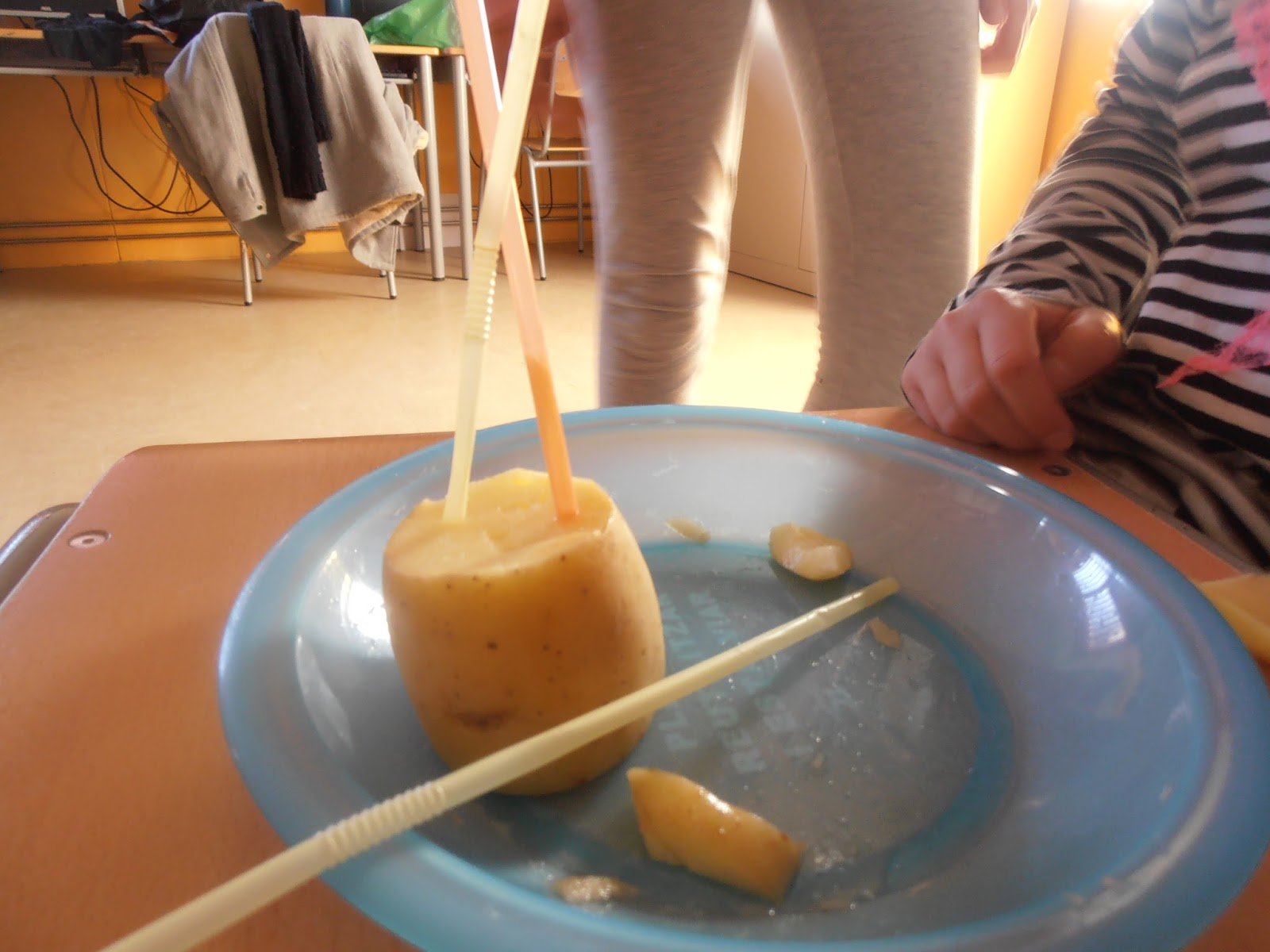
USE A STRAW TO STAB A POTATO


WE NEED:
  • Plastic drinking straws.
  • A raw potato.


HOW TO DO IT:
  1. Take the plastic drinking straw.
  2. Try quickly stabbing the potato.
  3. Repeat the experiment with a new straw.
  4. Put your finger over the top, covering the hole.
  5. Try quickly stabbing the potato.    
    
PREDICTIONS:

The straw is going to stab the potato in both tries.


RESULTS:
Placing your thumb over the hole at the top of the straw improves your ability to pierce the potato skin and push the straw deep into the potato. The first time you tried the experiment you may have only pierced the potato a small amount, so why are you more successful on the second attempt?
Covering the top of the straw with your thumb traps the air inside, forcing it to compress and helping the straw not being deformed as you stab the straw through the potato skin. This makes the straw strong enough to pierce the potato, unlike the first attempt where the air is pushed out of the straw.


STRAW
+
THUMB (AIR TRAPPED - COMPRESSED)
=
PIERCED POTATO

MY OPINION: 
This experiment has been great because I did not expect the straw is nailed to the potato.

BY: ALBA

TASTE TESTING WITHOUT SMELL


WE NEED:
  • A small piece of peeled potato.
  • A small piece of peeled apple (same shape as the potato so you can't tell the difference)


HOW TO DO IT:
  1. Close your eyes.
  2. Mix up the piece of apple and the piece of potato.
  3. Hold your nose.
  4. Eat each piece, can you tell the difference?


PREDICTIONS:
We think that we are going to recognise the apple and the potato.


PROCESS:


RESULTS:
Some of us could recognise the food, but others couldn't!

Your nose and mouth are connected through the same airway, which means that you taste and smell the food at the same time. 
Your sense of  taste can recognize salty, sweet, bitter and sour. When you combine this with your sense of smell you can recognise many other individual 'tastes'. Take away your smell (and sight) and you limit your brain's ability to tell the difference between certain foods.

MOUTH: SENSE OF TASTE (salty, sweet, bitter and sour)
+
NOSE: SENSE OF SMELL
=
A LOT OF TASTES


MOUTH
-
NOSE
=
DIFFICULT TO DIFFERENTIATE SIMILAR TASTES


MY OPINION:
I liked it very much because it has been fun and I laughed a lot.


BY: ALBA


martes, 9 de febrero de 2016

FOOD COLOURING & BLEACH

WE NEED:
          
  • A glass
  • Water
  • Food colouring
  • Bleach

HOW TO DO IT:

  1. Put some water in the glass.                                                                                                                             
  2. Add food colouring.                                                                                                                                     
  3. Add some bleach.                                                                                                                         
  4. Mix it.                                                                                                                                                                                                                                                                          

PREDICTIONS:


RESULTS:


There is a component in the bleach (sodium hypochlorite) that is a strong oxidant. This means that it takes electrons from other compositions, discolouring them. To sum up, bleach "steals" electrons from food colouring and they can't colour the water anymore.

FOOD COLOURING (electrons)
+
BLEACH (sodium hypochlorite = oxidant)
=
NO COLOUR


MY OPINION:

I like the experiment because the bleach changed the colour of the food colouring.


                                                                                                        BY: Dèlia